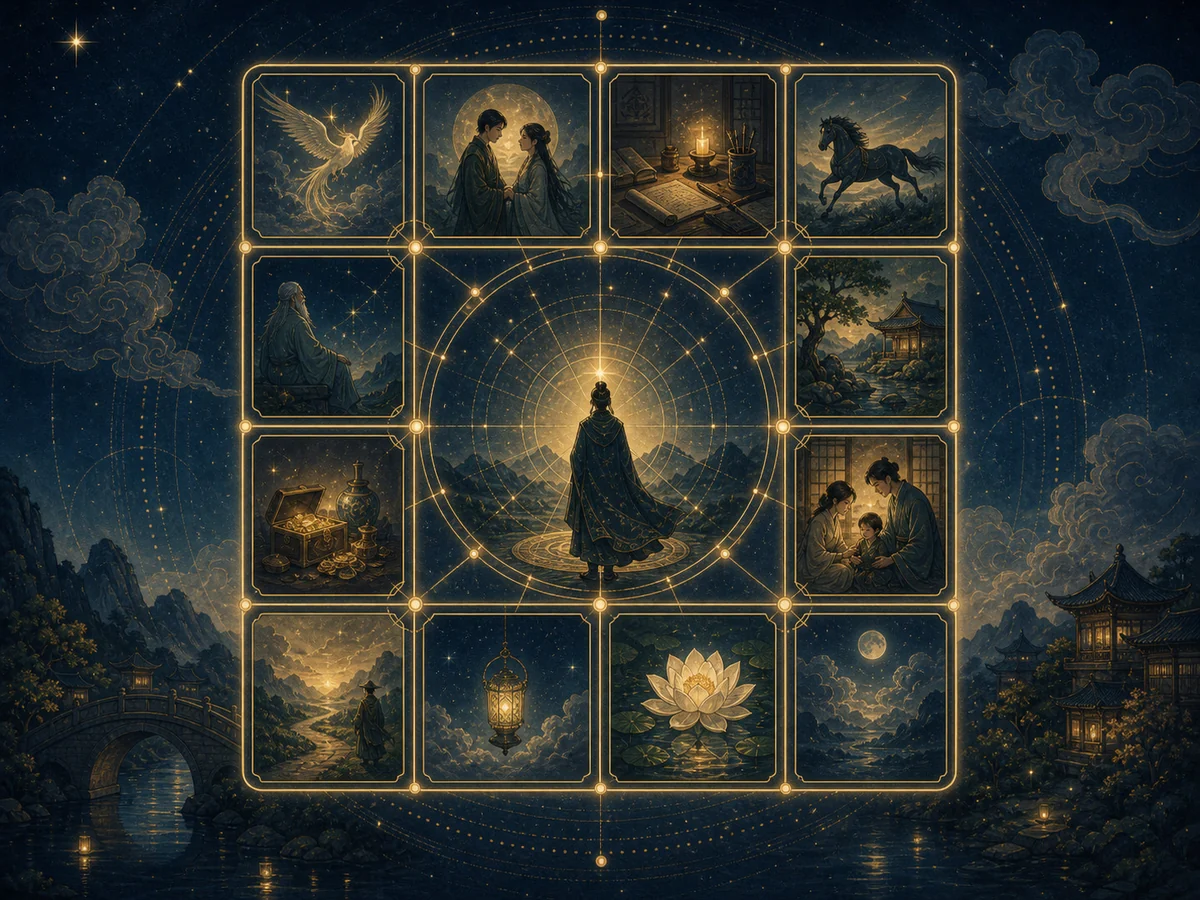
The twelve palaces of Zi Wei Dou Shu categorize life experiences into twelve distinct areas of observation. The palaces themselves indicate “what is being examined,” the stars (stars/deities) reveal “how this area typically functions,” and the relationships between the palaces help us understand how these different aspects of life influence one another.
Before exploring this topic, it is recommended to first review the “sequence for reading a Zi Wei Dou Shu chart” to establish a holistic perspective; avoid drawing conclusions based solely on an individual star or a single palace. When analyzing the twelve palaces, first identify which life domain your question pertains to, then examine how the relevant palaces either support or constrain one another.
Understanding through case studies: From specific points to the entire chart.
When interpreting a chart—focusing on the question, “What do the twelve palaces represent?”—do not rush to determine whether something is “auspicious” or “inauspicious.” A more reliable approach is to first identify which palace or temporal layer the issue concerns, and then assess what support it receives—or what limitations it faces—within the context of the entire chart.
If you have not yet established a framework for the whole chart, you may wish to first refer to: The recommended sequence for beginners reading a chart. When an assessment involves multiple palaces, use the “overall structure of the San Fang Si Zheng (the three harmonious sectors and the opposing sector)” to check whether the palace in question, its opposite palace, and the associated harmonious palaces resonate with one another.
You can begin by learning the themes of the twelve palaces before delving into the details of each individual palace. For example: The Property Palace (Tian Zhai Gong) This concerns not only real estate but also one’s sense of security in their living environment. The Wellbeing Palace (Fu De Gong) This relates not just to enjoyment, but also to mental rejuvenation and long-term fulfillment.
It is best to explore the twelve palaces one by one; there is no need to memorize everything at once. You might start with: The support system represented by the Palace of Parents (Fu Mu Gong) And The peer resources represented by the Palace of Siblings (Xiong Di Gong) This will help you understand how these “relational” palaces influence your real-life interactions.
The twelve palaces (houses) serve as the primary coordinate system in Zi Wei Dou Shu (Purple Star Astrology); this structure differs from the “four pillars” (BaZi) framework. To understand how each system organizes information, continue reading below. How to compare BaZi and Zi Wei Dou Shu.
- First, ensure that your birth data and the chart-plotting rules you are using are reliable.
- Next, separately document the palaces, major stars, the “four transformations” (Si Hua), and the relevant temporal layers (timeframes).
- Finally, validate your findings through long-term experience rather than relying on a single event to “prove” the accuracy of a birth chart.
If a conclusion is derived from only one star or one palace, it must be cross-referenced. Examine the relationship patterns within the Spouse Palace (Spouse Palace). Also, consider related or adjacent topics to ensure you haven’t overlooked the flow of resources, shifts in responsibilities, or real-world choices.
The core themes of the twelve palaces.
- The Life Palace (Ming Gong) reveals one’s fundamental orientation and starting point in life; the Siblings Palace (Xiong Di Gong) concerns peers and collaboration.
- The Spouse Palace (Fu Qi Gong) relates to intimate relationships and expectations regarding partnerships; the Children Palace (Zi Nu Gong) pertains to creativity, caregiving, and the younger generation.
- The Wealth Palace (Cai Bo Gong) concerns the utilization of resources; the Health Palace (Ji E Gong) relates to physical experiences and patterns of stress.
- The Travel Palace (Qian Yi Gong) concerns the external environment; the Servants/Friends Palace (Pu Yi Gong) relates to colleagues, friends, and collaborative networks.
- The Career Palace (Guan Lu Gong) concerns professional expression; the Property Palace (Tian Zhai Gong) relates to one’s domestic space and the accumulation of assets.
- The Virtue/Fortune Palace (Fu De Gong) concerns inner fulfillment; the Parents Palace (Fu Mu Gong) relates to elders, institutional influences, and sources of support.
Palaces should not be interpreted in isolation.
Each palace must be analyzed in conjunction with its opposing palace, the “three harmonies and four cardinal points” (san fang si zheng), and the specific state of the stars within it. For instance, career matters are not determined solely by the Career Palace; they are shaped by the interplay between the Life Palace, the Wealth Palace, the Travel Palace, and the Career Palace itself.
How should one make assessments within the context of the entire birth chart?
First, identify which palace or temporal layer is under discussion, then examine its relationship with the opposing palace, the “three harmonies and four cardinal points,” and the “four transformations.” If a judgment is based on only a single point, consider… Do not rely on a single palace alone. Check whether you have overlooked factors such as support, tension (opposing forces), or practical avenues for manifestation.
- Examine the overall structure first, then look at the details of the individual stars.
- Outline potential manifestations first, then verify them against long-term, observed experience.
- If birth data is uncertain, keep your conclusions flexible.
Which houses (palaces) should you look at first?
Beginners can start with the Life Palace (Ming Gong) and its associated “three directions and four cardinal points” (the primary alignment), then move on to the houses most relevant to their current concerns. Focusing on one set of relationships at a time is easier to grasp than methodically checking every single star in every house.
The names of the houses are not literal, restrictive definitions.
The Spouse Palace (Fu Qi Gong) is not limited to those who are married; it can also reveal insights into intimate partnerships and expectations within relationships. Similarly, the Children Palace (Zi Nu Gong) may relate to creative projects or one’s approach to caregiving. Always ground your interpretation in real life.
How can you verify your understanding of the “Twelve Houses” in Zi Wei Dou Shu?
When analyzing the Twelve Houses, first note two or three potential manifestations suggested by the chart’s structure, then validate them against long-term, recurring real-life experiences. Do not cherry-pick a single past event that happens to fit the description, and never overlook the profound influence of upbringing, family background, geography, career, and personal choice.
Zi Wei Dou Shu is best used as a structural language for organizing life experiences, rather than as a set of rigid identity labels. A sound interpretation should highlight both strengths and areas of pressure, while offering potential avenues for adjustment—and it should clearly acknowledge any uncertainty when birth data or real-world information is incomplete.
Common pitfalls include focusing on a single star or house in isolation, treating terms like “auspicious” or “inauspicious” as guaranteed outcomes, or ignoring real-world evidence in an attempt to force reality to fit the chart. Every judgment should be cross-referenced with the overall structure and long-term experience, while allowing for the fact that personal choices can alter how these patterns manifest.
How can you avoid “labeling” people based on their charts?
The value of Zi Wei Dou Shu lies in identifying behavioral tendencies and thematic phases of life, not in locking a person into a fixed destiny. If a theme involves the flow of resources, responsibilities, or points of stagnation, you can look to the “houses of intimate relationships” to gain a more comprehensive structural perspective on how these dynamics play out in reality.
This text is intended for the study of traditional culture and self-exploration; it is not a substitute for professional advice in fields such as medicine, law, or investment.


